AGAPE FOUNDATION INCFaith · Service · Development

The Film

Section by section

A 3 minute 59 second documentary in four movements. Sections I–III are documented history, cited to primary sources. Section IV is theological reflection, labelled as interpretation on screen and here.

Watch the film on the introduction page →

I

U.S.–Morocco Treaties, 1786 and 1836

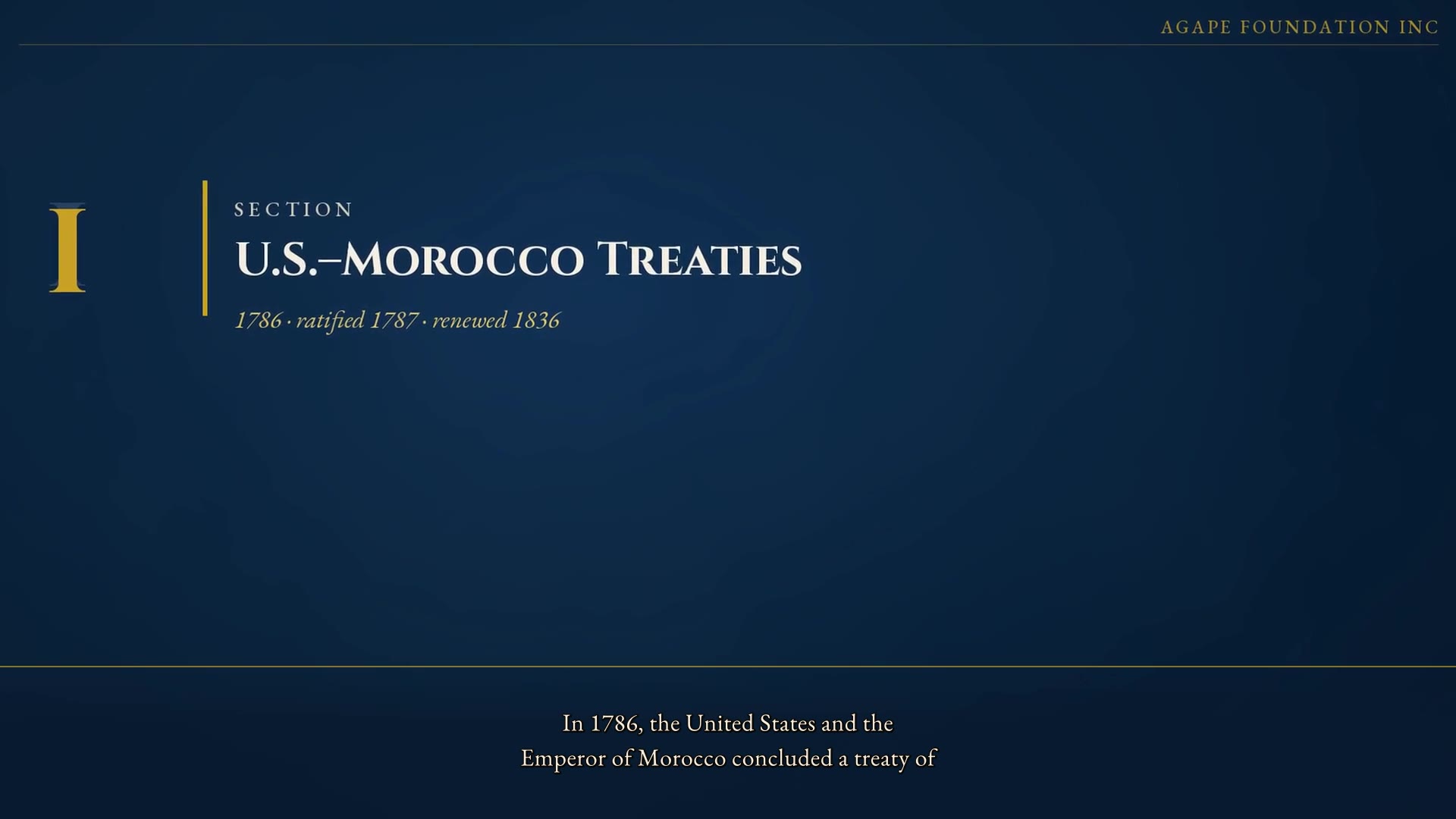
In 1786 the United States and the Emperor of Morocco concluded a Treaty of Peace and Friendship. It was sealed at Morocco that June, with an additional article on 15 July 1786 and a ship-signals agreement on 6 July 1786. Certified English translations were signed by Thomas Jefferson at Paris on 1 January 1787 and by John Adams at London on 25 January 1787. The United States ratified and proclaimed the treaty on 18 July 1787.

The treaty’s 25 articles concern peace, commerce, ships and citizens: neither party was to take a commission from the other’s enemy or fight under their colours; trade was to stand on the footing of the most favoured nation; vessels in distress could put into port, repair and reload cargo without paying duty; citizens were to be protected; and prisoners were not to be made slaves but exchanged.

“If any Vessel of the United States shall meet with a Disaster at Sea and put into one of our Ports to repair, she shall be at Liberty to land and reload her cargo, without paying any Duty whatever.” Article VIII, certified English translation, 1787

At Meknes on 16 September 1836 the treaty was renewed, and again ratified by the United States — on 28 January 1837, proclaimed 30 January 1837. The renewal provided that it would continue in force for fifty years, and thereafter remain binding until either party gave twelve months’ notice.

What the treaty did not do. It did not transfer ownership of America. It did not establish Indigenous Americans as Moroccan subjects. It was a compact between two sovereign powers — the United States and the Empire of Morocco — and it said nothing about the homelands of Indigenous nations within the United States.
Read the quotations in full →

A treaty page shown in the film, quoting the 1786 Treaty of Peace and Friendship
II

Indigenous Nations and the Louisiana Purchase

The film honours Indigenous nations in the present tense: distinct histories, living cultures, enduring homelands, and sovereignty. These are nations that make their own laws, hold their own lands and waters, and carry their languages, arts and ceremonies forward — not relics of the past.

In 1803 the United States paid France $15,000,000 for territorial claims covering approximately 828,000 square miles — roughly 2.1 million square kilometres. The film shows the transfer of claims on a map drawn from public-domain geographical data, with the purchase boundary marked as illustrative.

The agreement was not Indigenous consent. Dozens of Indigenous nations already lived there, with their own governments, languages and homelands. France ceded the claims it asserted; it did not, and could not, sell what those nations had never surrendered. The film states this plainly rather than implying it.

Sources for this section →

A map card from the film showing the Louisiana Purchase of 1803 and the nations whose homelands it covered
III

Judah and Jerusalem

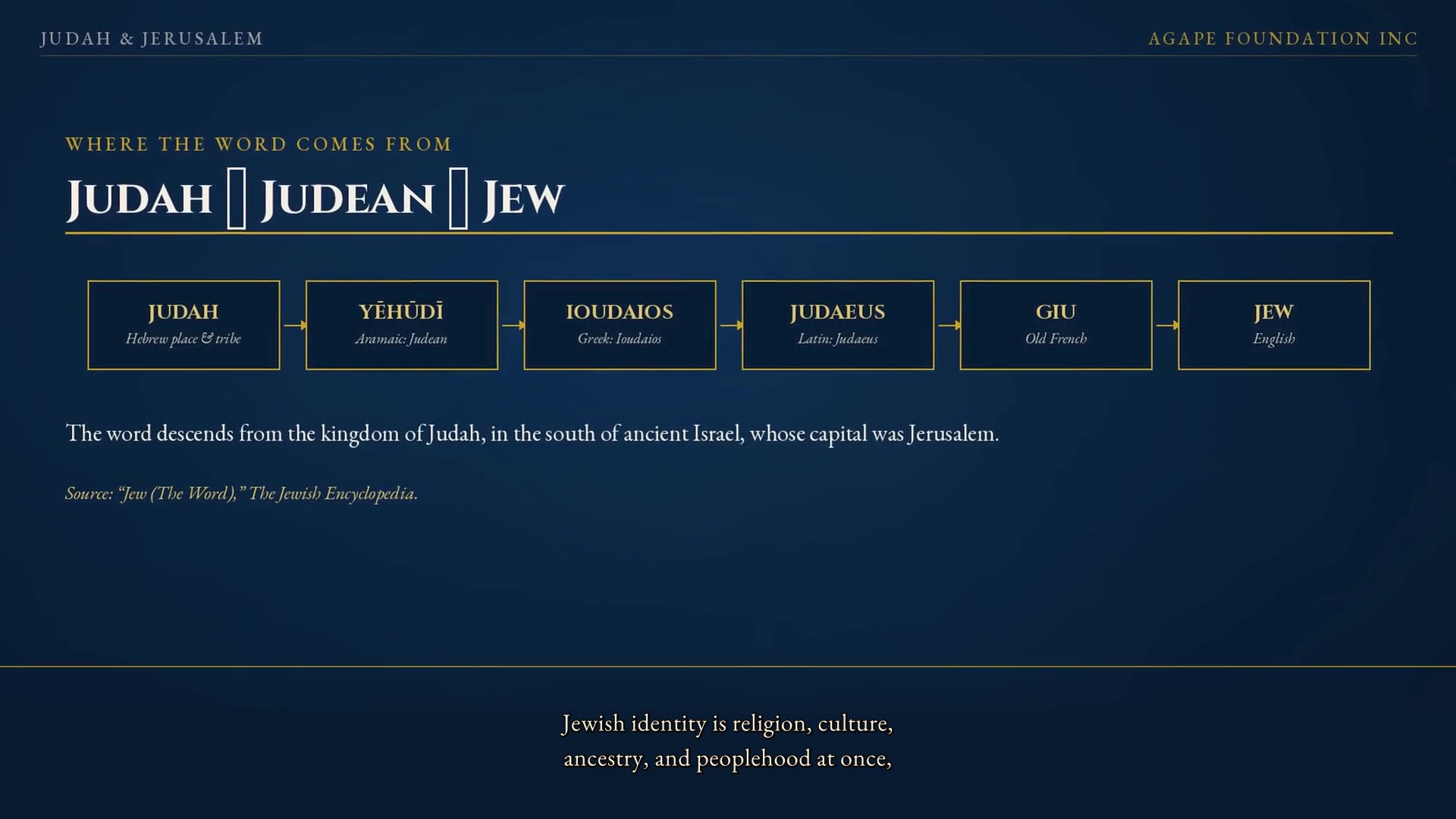
The film begins in the kingdom of Judah, in the south of ancient Israel, whose capital was Jerusalem. From that place-name comes a word for a people: Aramaic Yĕhūdī, “Judean”; Greek Ioudaios; Latin Judaeus; Old French Giu; and finally English Jew. The word “Jew” is, at root, a geographic and kinship term before it is anything else.

Jewish identity is then described as what it is — one people across four dimensions:

  • Religion — covenant, law, prayer and practice.
  • Culture — language, literature, music and memory.
  • Ancestry — family lines and shared history.
  • Peoplehood — a people bound together across generations.

Distinct, not conflated. Jewish, Moroccan and Indigenous identities are separate. The film keeps them separate and asserts no shared ancestry between them.

The etymology source →

A card from the film showing the chain Judah, Yehudi, Ioudaios, Judaeus, Giu, Jew
IV

Spiritual reflection: “Regaining Judah”

Theological interpretation — not evidence

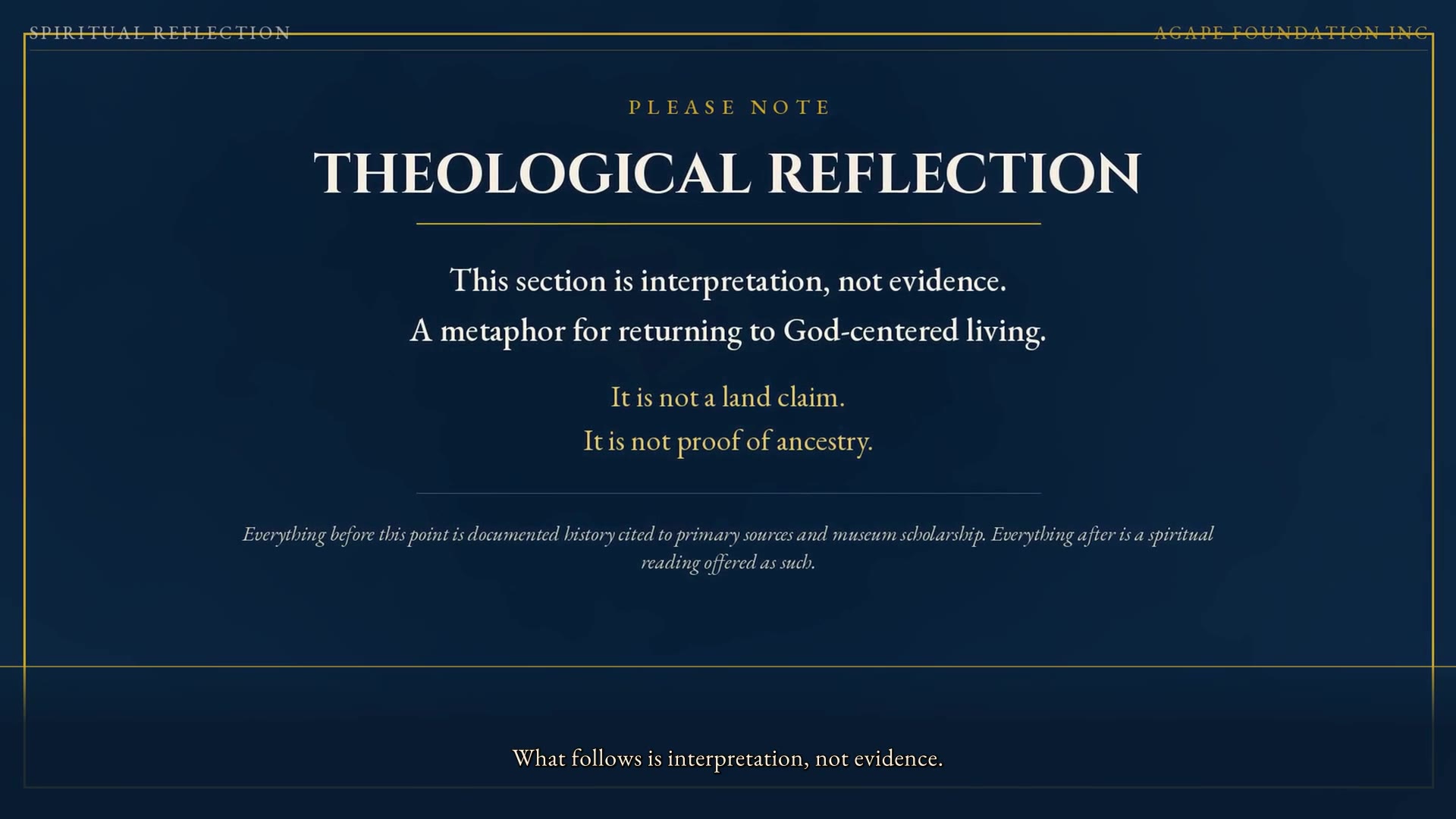
This section is labelled on screen, in these words: “This section is interpretation, not evidence. A metaphor for returning to God-centred living.” The film states that it is not a land claim and not proof of ancestry.

“Regaining Judah” is offered as a metaphor for returning to God — recovering humility, justice, and a heart turned back. The film turns to two kings:

  • Saul — Israel’s first king. He began in humility and ended in disobedience.
  • David — of a different family line. A shepherd who became king, and who failed gravely too.

David’s turning point is named as repentance, mercy and correction: he grieved his sin, he sought forgiveness, and he accepted being told the truth. The lesson the film draws is not that greatness excuses wrongdoing, but that leaders answer for their choices — and that future generations can learn from both men’s stories rather than from their failures alone.

How the film marks interpretation →

The theological reflection card from the film, stating that the section is interpretation, not evidence
V

Agape in action

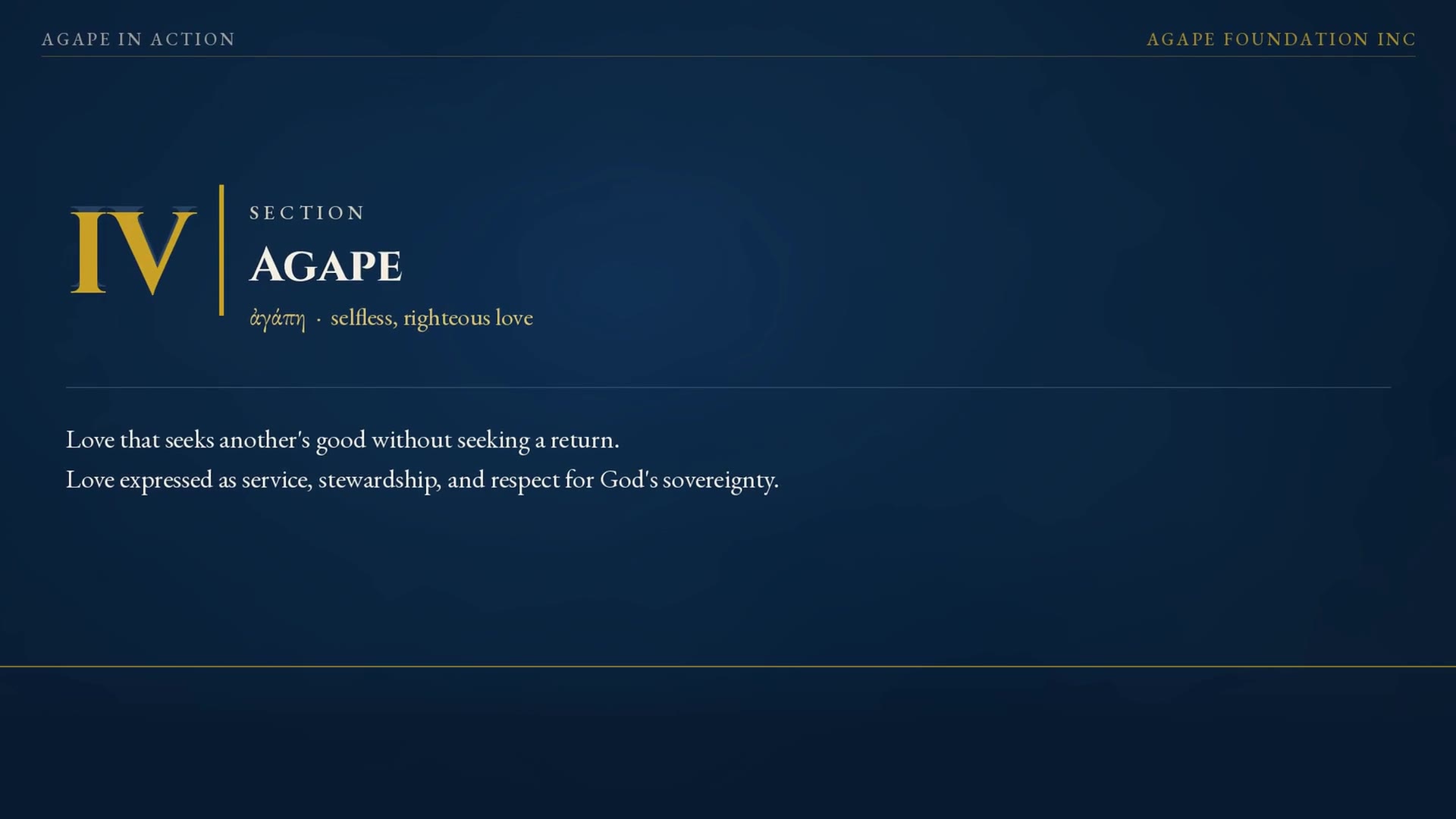
Agape is love that seeks another’s good without seeking a return. The film presents it as selfless, righteous love expressed through service, ethical stewardship, responsible living, justice, and respect for God’s sovereignty.

For an organisation, that love has a shape. The film describes three commitments:

  • Transparent budgets — spending that can be seen and understood.
  • Responsible commitments — promises limited to what can honestly be kept.
  • Sustainable service — work that does not borrow against its own future.

Debt-free practice is an aspiration, not a claim. The film says so on screen: “We are not claiming to be debt-free today. This is the standard we are working toward.”

The film closes: “Study the treaties. Honor Indigenous sovereignty. Serve with agape.”

The Agape section card from the film

Production note

What is original, and what is transcribed

Treaty pages shown in the film are typographic transcriptions of the published primary-source text, clearly labelled on screen as primary-source quotations — not photographed archival documents, and not presented as facsimiles.

Maps are rendered for the film from public-domain Natural Earth boundary data. The 1803 purchase boundary is drawn illustratively, as the film states on screen. Atmospheric imagery is original to the film, credited as generated imagery in the source list. Narration is a synthetic documentary voice-over; the score is original to the film.

Watch the full film →  ·  Download the source list (PDF) →